A/B Test Experiment Plan
Insight
Timer
Can gamification increase young adults' use of a meditation and mindfulness app, and improve their mood along with it?
Collaborators
Adaeze Ezekwerre · Annie Doctrow · Lesley Pace · Marissa Villano
INFO 615 — Dr. Jina Huh-Yoo
Goal
- As consequences of the COVID-19 pandemic linger on, increase young adult utilization of the meditation and mindfulness app Insight Timer by introducing gamification
The Problem
As a result of the COVID-19 pandemic, the cost to protect physical health resulted in declined mental health. Consequences such as isolation, job loss, school closures, lack of childcare, restricted access to mental health care, and greater exposure likelihood put young adults at a higher risk of facing mental health issues during the pandemic (Panchal, et al 2021). Already at a higher risk of poor mental health even prior to the pandemic, Panchal et al write that fifty-six percent of young adults reported symptoms of anxiety and or depressive disorder during the pandemic (2021).
To help combat these symptoms, virtual meditation and mindfulness resources are gaining popularity as free or low-cost solutions. A longitudinal observational study by Stecher et al that examined app-based meditation habits and the associated mental health benefits found that routine use of the app allowed for users to form reflexive meditation habits and that the users associated their routine use with greater perceived mental health benefits (2021).
Furthermore, with the key being routine use of the app, a systematic review of 1,017 intervention studies targeting engagement of adult web and or mobile users suggests that "gamification can increase engagement in online programs and enhance related outcomes, such as learning and possibly health behavior" (Looyestyn 2017).
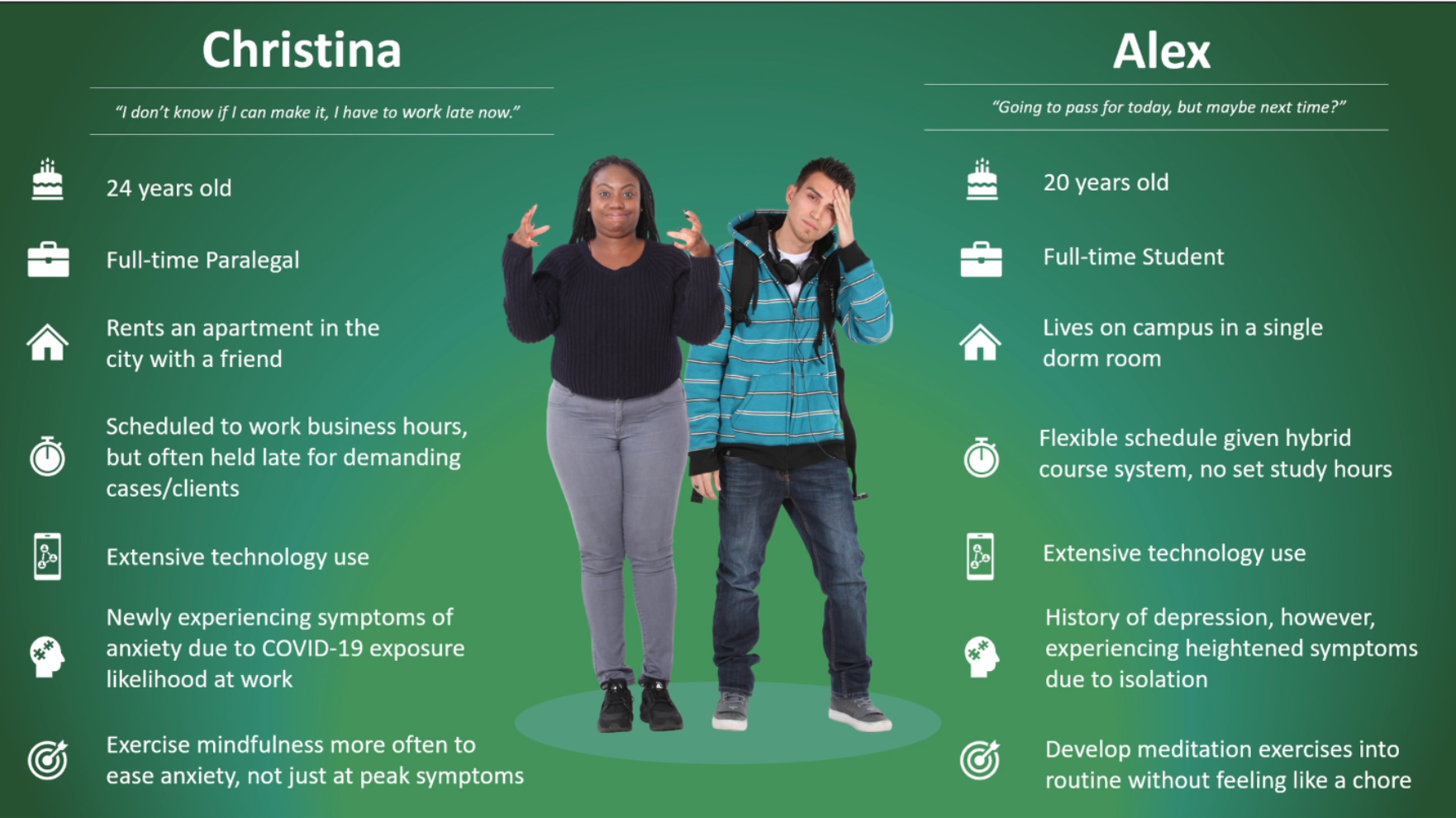
User Personas
Hypothesis
- If we apply gamification to Insight Timer, then the added engagement will drive user utilization of the app, which will positively impact the user session daily frequency.
- Additionally, if the user session daily frequency increases over time, we expect to see our secondary metric, daily mood, to reflect general improvement over the same period of time.
Methodology
An A/B test comparing the current app against a gamified version of it.
Test Cells
- Experiment type
- A/B test
- Test Cell A
- The current version of Insight Timer
- Test Cell B
- The current version of Insight Timer with gamification
Metrics
- Primary
- Session daily frequency
- Secondary
-
- Daily mood tracking feature
- Demographics
Data Collection & Analysis
- Duration
- Longitudinal data collected over the course of 6 months
- Exposure
- 10% of users will receive the added gamification
- Sources
-
- Quantitative data collected from unmoderated user logs
- Quantitative and qualitative data collected through self-reporting
- Analysis
- An independent t-test will be used to analyze the data
Recruitment
Test cells are randomly selected so they represent the portion of the user base the experiment sets out to learn about.
Segmentation
- Age
- Young adults, defined as individuals between 18 and 29
- Location
- The United States
- Rationale
- This age group is expected to use technology similarly and to share common values and expectations
- Behavior
- Not segmented, given the exploratory and global nature of the experiment
- Experience level
- All levels included: new users, existing users and current routine users
Sample Size
- Share of users
- 10%
- Why this size
-
- Gamification is not required to keep using the app, so there is no urgency to roll the feature out more widely
- Mental health varies widely from person to person, and only scale separates a real trend in the secondary metric from coincidence
Study Window
- Period
- June 2022 through December 2022
- Export cadence
- Daily user data exported weekly
- Week definition
- Monday at 12:00AM to Sunday at 11:59PM local time, for a clean cut-off
- Why six months
-
- Enough time for a habit to form and also to break
- Long enough to surface seasonal effects, such as Seasonal Affective Disorder in winter months driving users to seek more mindfulness or meditation
Potential Failures
Two ways the experiment could return a result we would not want to act on.
- Gamification may not have the desired impact and could result in the opposite effect, leading to change aversion, loss of results and usage decline
- The project may result in novelty effect, which could indicate that the feature can only have temporary success
Lessons Learned
Five takeaways from designing the experiment, each one a change we would make running it again.
-
More design cells
A wider set of cells would give a full view of impact per demographic breakout.
-
Longer test windows
More time on test would account for change aversion and the novelty effect.
-
Secondary research
It builds the proof of concept and the reasoning for pursuing a hypothesis.
-
Methods beyond gamification
Evaluating other approaches widens the scope of what could drive usage.
-
Metrics that fit
Metrics must match the hypothesis, and measuring impact can take unconventional forms.
Conclusion
Future Goals
- Testing on additional age groups
- Testing sustainability
Contributions
- Applying gamification to a mindfulness app to drive increased engagement and routine use
- A potential solution for improving young adults' mental health during the COVID-19 pandemic and beyond
Experiment Plan
The full plan submitted for the course, covering the data collection plan, analysis and results framework in detail.
Insight Timer Experiment Plan Abstract, introduction, data collection plan, analysis and expected results. View .pdf →References
- Dwyer, K. (2022). Why therapists are worried about mental health in America right now: Times insider.
- King, Churchill, E. F., & Tan, C. (2017). Designing with data: improving the user experience with A/B testing (First edition.). O’Reilly.
- Looyestyn, Jemma, et al. (31 Mar 2017). Does gamification increase engagement with online programs? A systematic review. PLoS ONE, vol. 12, no. 3, p. e0173403. https://doi.org/10.1371/journal.pone.0173403.
- Panchal, N., Kamal, R., Cox, C., & Garfield, R. (2021, February 10). The implications of COVID-19 for mental health and substance use. KFF. Retrieved April 10, 2022, from kff.org/coronavirus-covid-19/issue-brief/the-implications-of-covid-19-for-mental-health-and-substance-use.
- Stecher, C., Berardi, V., Fowers, R., Christ, J., Chung, Y., & Huberty, J. (2021, November 23). Identifying App-Based Meditation Habits and the Associated Mental Health Benefits: Longitudinal Observational Study. Journal of Medical Internet Research. Retrieved April 10, 2022, from https://www.jmir.org/2021/11/e27282. https://doi.org/10.2196/27282.
- Zhang, Renwen, Natalya N. Bazarova, and Madhu Reddy. (2021). Distress Disclosure across Social Media Platforms during the COVID-19 Pandemic: Untangling the Effects of Platforms, Affordances, and Audiences. In Proceedings of the 2021 CHI Conference on Human Factors in Computing Systems (CHI ’21). Association for Computing Machinery, New York, NY, USA, Article 644, 1–15. https://doi.org/10.1145/3411764.3445134.