Prevalence
Estimated ADHD diagnoses in USA (2023)
- 7‑18% all children
- 4‑4.5% all adults
However,
- ADHD is a lifespan neurological disorder
- Not simply outgrown with age
- 60‑80% of ADHD symptoms continue into adulthood
UX Research Case Study
How does the design of online learning platforms shape the experience of adult learners with attention‑deficit/hyperactivity disorder?
Estimated ADHD diagnoses in USA (2023)
However,
In adults, this looks like:
The project moved through four stages, each one feeding the next.
Step 01
To start my research, I looked to existing publications that might offer insight into my research question. Below is a recap of some of the most relevant work to my project, however, I failed to find a resource that studied the same intersectionality of adult ADHD and online learning.
Step 02
Step 03
Using Dovetail, transcripts were reduced to notes, then clustered bottom‑up across five passes until stable themes emerged.
Every session transcribed in full and stripped of identifying detail.
Individual observations pulled onto discrete notes, one idea per note.
Notes grouped by similarity without predetermined categories.
Each cluster named, split or merged as the grouping settled.
Themes translated into the design considerations below.
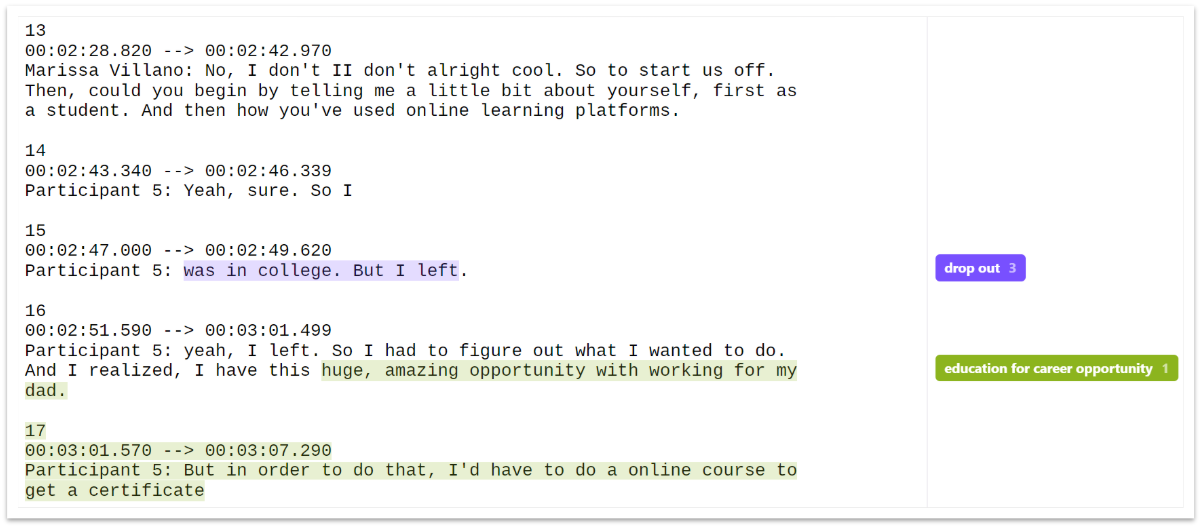
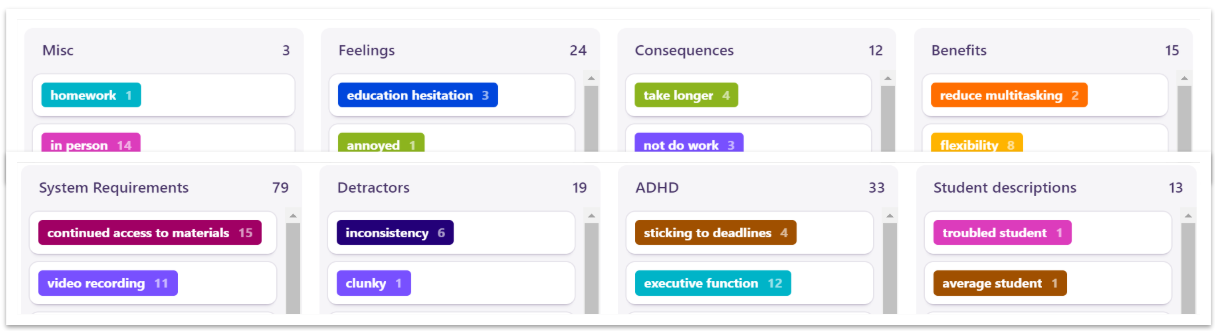
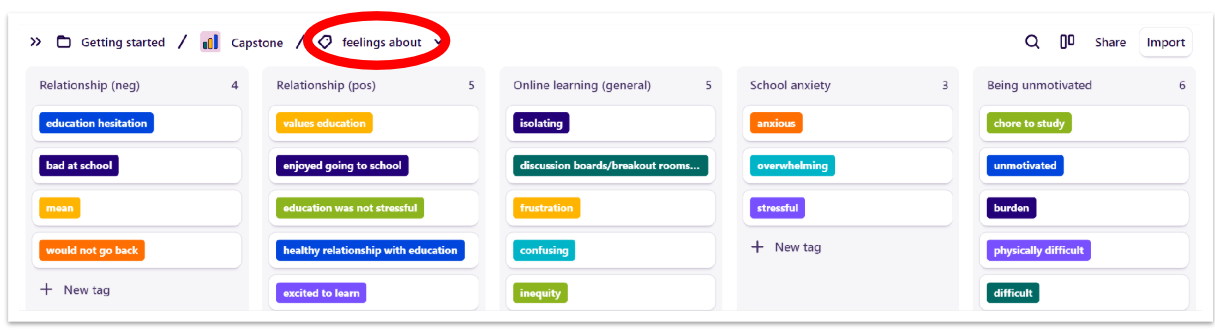
Seven categories emerged from the clustering, each holding its own set of sub‑categories.
Step 04
Eight considerations for teams building and or researching learning products, based on participant insight.
Helpful to be able to calibrate where they are in the course/content in terms of what they have already completed and what still remains open.
Reduces feeling overwhelmed with outstanding assignments and due dates.
Clear tracking of individual grades and their weights towards the final grade helps them see their success in the course and or where effort needs to be allocated.
Easy to hyperfixate on low-value add work when there is time-extensive work waiting to be completed.
Easy to lose interest in things and thus lose motivation to do said uninteresting things.
For example, Participant 9 described the relationship between grades and interest level as directly related: “if it's something I'm not super interested in, I'd say that's less favorable for my grades. And then, if it's something I'm interested in, that tends to be better in terms of the grades.” Similarly, they described that it felt “kind of a chore like a chore to study because if it wasn't something I felt like I was interested in, then there was no like spark to try, in a sense.”
Need something to maintain interest and motivation; for many it is the threat of failing.
Due dates for deliverables need to be apparent, clear, and easy to find. If this information is mixed in with other details or not in the place they would expect it to be, they will lose track.
Even if a due date is clear, automated reminders and notifications help combat time blindness and forgetfulness.
Participant 3 attributes a positive impact to their online learning to “just knowing when an assignment is due and then also, you know, just getting the email reminders like you have an assignment due in two days or whatever is helpful to stay on top of things.”
The online platform serving as a “one stop shop” for all course materials and documents helps provide security as it removes the possibility of them losing a paper copy like in traditional settings.
Having a source of truth updated directly by the instructor eases concerns about missing critical notes about due dates / details jotted down somewhere or having outdated/incorrect information without realizing.
Searchability for and within documents is important. If the information cannot be found due to disorganization or no search feature, then its utility is partially lost by the manual effort to find it.
Knowing that a lecture is going to be recorded and be available online allows for active listening during the lecture and eliminates hectic/distracting notetaking practices, both allowing for more effective learning.
Task paralysis / difficulty breaking down steps to tackle time/effort intensive work.
For example, Participant 5 described how “When there's a lot of things in front of me that I have to do, I can't like focus on just the one I see. Like if I have 4 assignments due it like stresses me out to the point of where I can't even do one at a time. That still bothers me today […] like right now, I have 4 different papers on my desk, and for the last hour I was refreshing Google's homepage.”
Without any enforced structure, they will put off the work until the last minute.
For example, Participant 10 said: “if you just give me every single lecture, and it's like watch one a week, I will not be doing that. I will be waiting until the last week. I will watch them all, and then I will finish the project. I cannot do it; I do not have the kind of discipline to do things incrementally.”
Types of activities and assignments vary by professor or area of study; some learn / perform better with one type versus another.
For example, Participant 8 reported easily getting bored and distracted due to the learning format but wished that professors “diversified the type of exam style instead of it just being reading and answering questions, or like essay writing. I think in higher academia that's really the only way that they gauge learners. I feel like when you're younger, they give other ways of presentation […] like, write a rap song, or like make a movie, or something like that, whereas in law school, because of the time constraint and the content that they have to teach in such limited time, the professors don't really care to focus so much on the pedagogy.”
Harder to ask questions about the course and its materials in a virtual setting than in a traditional setting.
May not know if the professor would answer in time/at all or understand/answer the question over written communication effectively.
Difficult to connect with classmates like they would in-person to form study groups or work together.
Participant 6 described working asynchronously and in isolation as feeling “very detached, so there was just no incentive to keep going.”
Discussion board post requirements, however, feel forced / unnatural and are not helpful in connecting with classmates.
Easy to wander away from learning platform to find something more engaging on the internet/device, especially without authority present.
For example, Participant 7 said that “if you have an assignment on BlackBoard [it's been normalized] to be clicking around on Google or on social media. I mean, yeah, it's much harder like online, since you're not forced in a classroom with the professor that can easily see what you're doing.”
The organization of the online course and its materials are highly dependent on the instructor, causing them to relearn and adjust to where content is with new instructors.
When they don't know where to look, they're more likely to lose their momentum or stumble upon something else and get carried away.